



Africa's Largest Shopping Mall
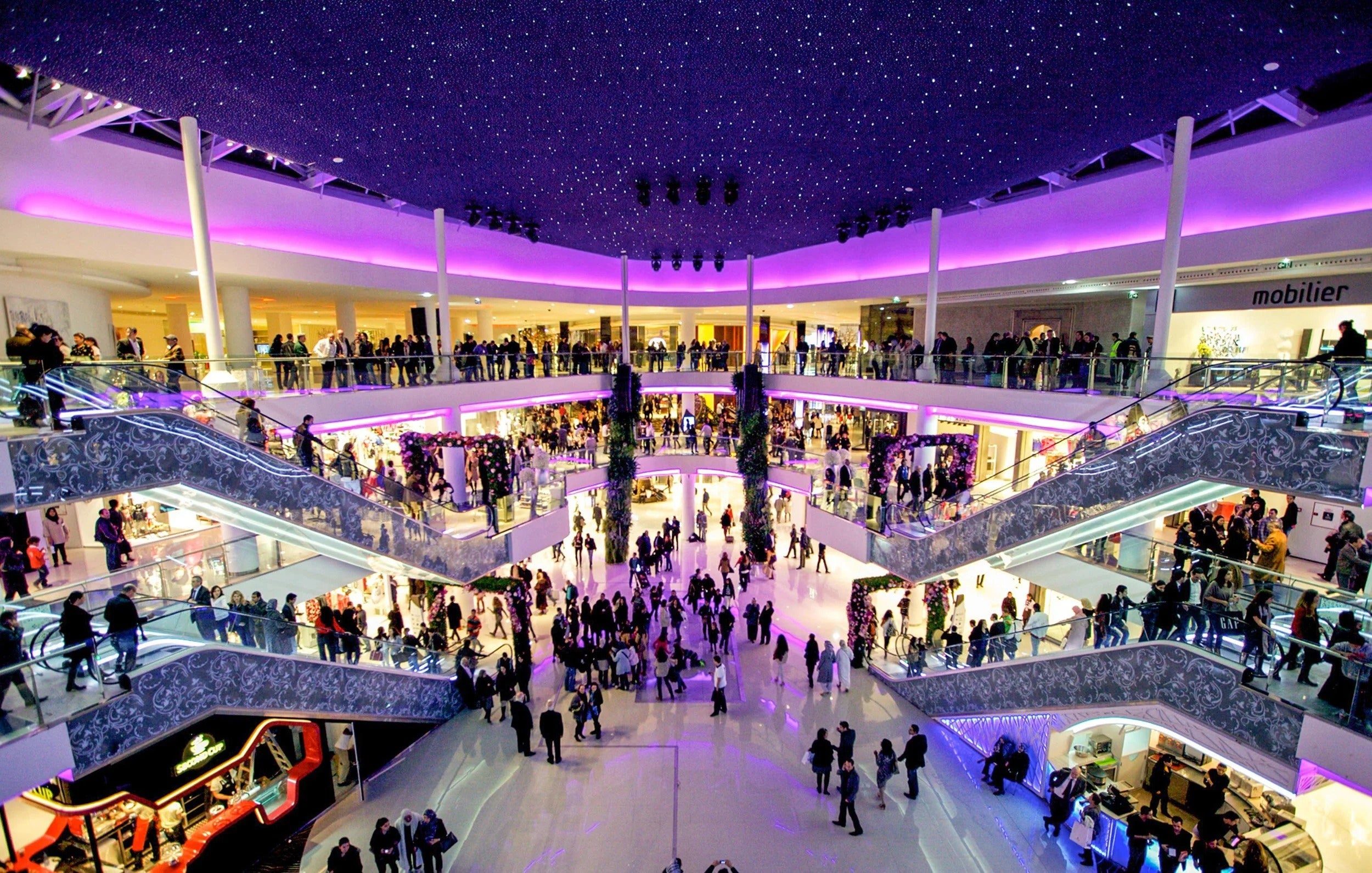
In sharp contrast to Casablanca’s Old Medina, Morocco Mall presents the city’s modern appetite at full scale.
An indoor aquarium rises through its central hall, an amusement park occupies an entire wing, and flagship luxury boutiques sit alongside cafés looking out toward Ain Diab beach just beyond the doors. It’s contemporary Casablanca on display: expansive, social, and designed for long afternoons that move easily between fashion, entertainment, and the sea.

Iconic RICK’S CAFÉ
Set on the Atlantic edge of the Old Medina, Rick’s Café was created as a living homage to the 1942 movie Casablanca.
Arched doorways, carved wood, and a grand piano echo the film’s imagined world, while the menu blends classic Moroccan dishes with European staples—less a replica, more a carefully staged piece of cinema brought into real life.


What to See & Do in Casablanca
Between wide boulevards, verdant courtyards, and the Atlantic's tempestuous waves, the White City exudes an unmatched energy
We love the tranquil Parc de la Ligue Arabe for its towering palms and neoclassical cathedral views. A stroll through the residential Quartier Ghibli reveals hidden lush gardens and the refined, quiet side of Casablanca’s urban life.

Over the Atlantic, Under a Minaret
Casablanca’s most audacious building sits on the ocean
The Hassan II Mosque is built directly above the Atlantic, so the city’s biggest landmark is also its most exposed one.
Carved cedar, polished marble, and dense zellige read as craftsmanship first, spectacle second. Guided visits allow rare access for non-Muslim travellers, including spaces where scale and detail are equally intentional. The sound of water and salt light shifts the entire experience, even before stepping inside.

Moroccan Heritage Meets Art Deco
Towering arches, Curved balconies, tiled entrances, and a city shaped by the twentieth century
Casablanca holds one of the largest collections of Art Deco architecture in the world, a result of rapid growth during the early twentieth century.
Downtown streets are lined with cream and white façades, rounded corners, wrought-iron railings, and generous arcades built for heat and light. The style is not preserved behind glass; offices, apartments, and cafés still occupy these buildings, giving the city its distinctive urban texture.

Exploring the Quartier Habous
Built in the early twentieth century, Quartier Habous was conceived as a new medina with order built into its bones
Streets are wide enough to pause, lined with shaded arcades, carved doors, and tiled façades that echo older Moroccan forms without their density.
The architecture is deliberate: proportioned courtyards, balanced sightlines, and materials chosen for durability as much as beauty. Bookshops stack titles at their thresholds, tailors work with doors open, metal trays and teapots catch the light outside small workshops. Cafés sit quietly along the lanes, drawing locals rather than crowds. Habous rewards attention not through spectacle, but through continuity—craft practiced, goods exchanged, and spaces used as they were intended.

Walking the Old Medina
Casablanca’s Old Medina sits close to the port, its streets pressed between ramparts and traffic
Stone walls, arched gateways, and whitewashed façades reflect a city rebuilt after the 1755 earthquake, where European and Moroccan influences sit side by side.
The scale is tight and direct, with little separation between movement, commerce, and daily life. Cafés spill onto the pavement beneath broad-canopied trees, drawing steady local crowds throughout the day. Cars edge past slowly, conversations overlap, and small workshops continue their work without interruption. This is not an ornamental medina; it is practical and exposed, shaped by proximity to the sea and the demands of a working port city.

Medina Qdima
Enter a different world and experience unfiltered Moroccan culture
You step through a stone archway and everything changes. Traffic noise drops behind you, replaced by voices calling prices, metal striking metal, carts rattling over cobbles. Vendors shout greetings from narrow stalls stacked high with oranges, dates, and pyramids of spice. Fabric hangs overhead, filtering the light, brushing shoulders as people pass. Donkeys edge through the lanes with loaded carts, bells cutting through the din as children dart ahead toward toy stalls and sweet sellers.
The medina moves by instinct. You pause as a handcart squeezes past, step sideways to avoid a spill of citrus, catch the scent of cumin, leather, sugar, and mint in quick succession. Hands work constantly—scooping spices, folding cloth, pouring tea—while conversation overlaps from every direction. It is crowded, loud, and alive, a compressed world operating on its own terms, separate from the wider city just beyond the walls.

A green retreat in the heart of the city
The expansive Mohammed V Square opens out around a broad fountain, drawing flocks of pigeons
Open and relaxed, this lovely court is framed by trees that soften the light through the middle of the day.
Within this open, green plaza, children happily ride the miniature train as it loops the square, bells cutting lightly through the sound of water.
Cafés line the edges, tables set close enough to watch the square’s easy choreography unfold. People cross without urgency, pausing for photos, shade, or a seat near the fountain. It works as a natural meeting point—central, legible, and quietly animated—offering a pause between the medina, downtown streets, and the wider city beyond.

Along the Ain Diab Corniche
As the sun lowers into the Atlantic, the shoreline fills with colour, movement, and evening ritual
At Ain Diab, the coast stretches wide and open, edged by cafés, beach clubs, and long promenades that draw people out as the heat fades.
Umbrellas cluster along the sand, conversations overlap, and the light turns the water copper and gold. It is less about swimming than presence—watching the horizon change while the city gathers behind you.
As dusk settles, the Corniche becomes a social thoroughfare. Walkers, families, and friends drift along the waterfront, pausing at café tables or leaning on the railings to watch the last light disappear. The ocean remains constant, but the energy belongs firmly to Casablanca—outward-looking, communal, and most alive at the end of the day.


Colourwashed Pattern, proportion, and craft
In Casablanca, zellige and carved stone are part of the city’s living tapestry
Thousands of hand-cut tiles are set piece by piece, forming dense geometric fields that read differently as light moves across them. Blues, greens, and ivory tones shift subtly against polished stone, the repetition exact without ever feeling mechanical. The patterns are mathematical, but their effect is tactile—cool underfoot, crisp at eye level.
Zellige works in harmonious tandem with carved arches and sculpted stone, guiding the eye through doorways and along colonnades. Nothing competes for attention; scale and restraint keep the focus on craft. These surfaces are made to endure washing, weather, and constant use, grounding Casablanca’s architecture in labour, skill, and generational continuity.
Casablanca gathers after dark
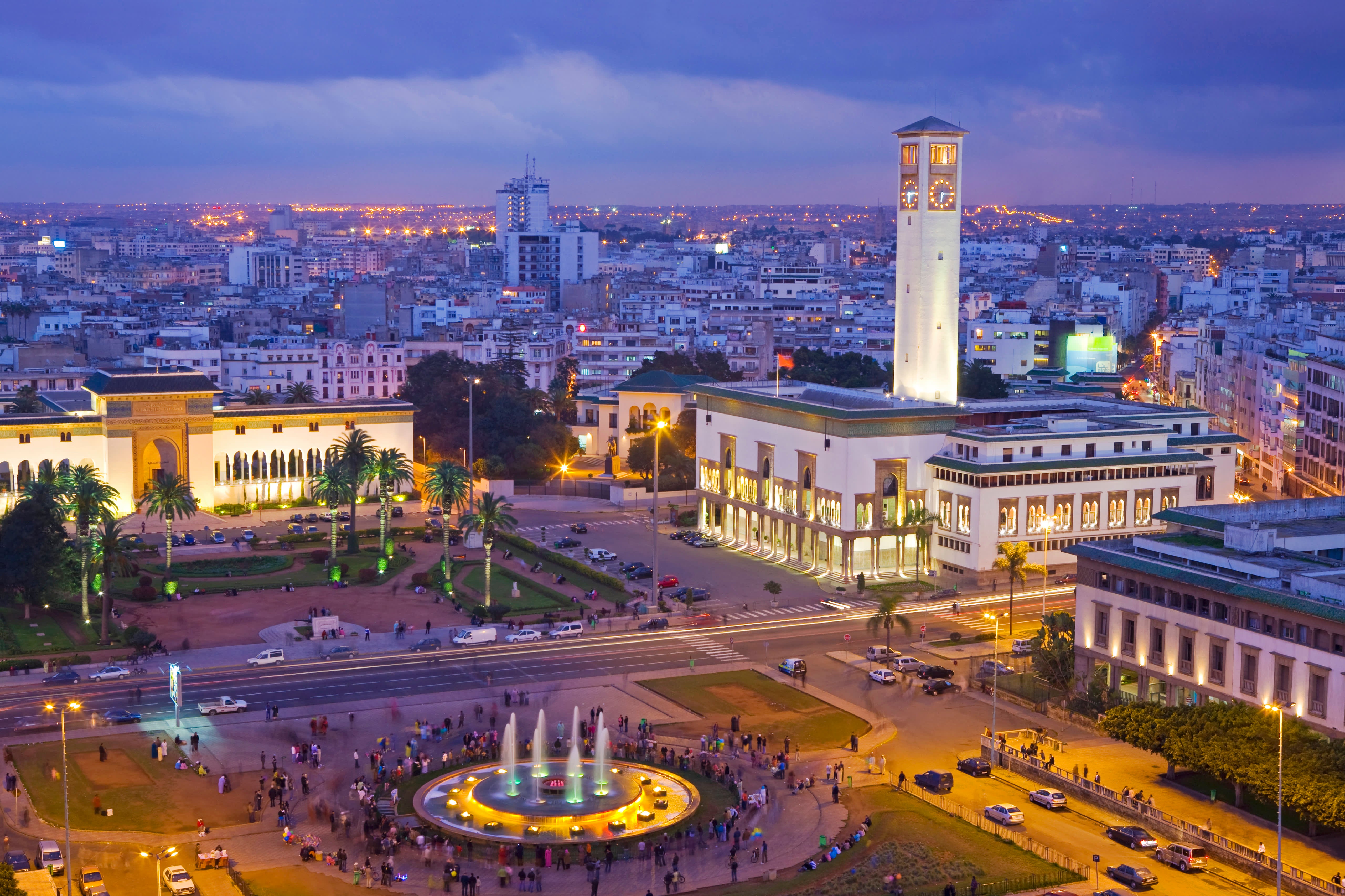
Evenings here belong to late tables, shared streets, and a city that saves its energy for its evening encore
Nightfall marks the city’s second wind. Families gather for a late meal, friends meet to talk in the streets, and dinners stretch long into the night. The air cools, lights come on, and conversation becomes the currency of the evening, carried across terraces and pavements well past what daylight would allow. Movement increases rather than fades, with short walks, café stops, and chance encounters folding naturally into the hours after dark.
Sunsets are spectacular, but twilight doesn’t linger. Once the sun dips below the ocean horizon and the heat eases, the city shifts quickly. Streets fill again, tables reset, and the evening opens fully. In Morocco, day and night operate on different frequencies, and Casablanca reveals its social life most clearly after daylight has passed.

Steam, stone, and a ritual woven into everyday life
Time in the Hammam
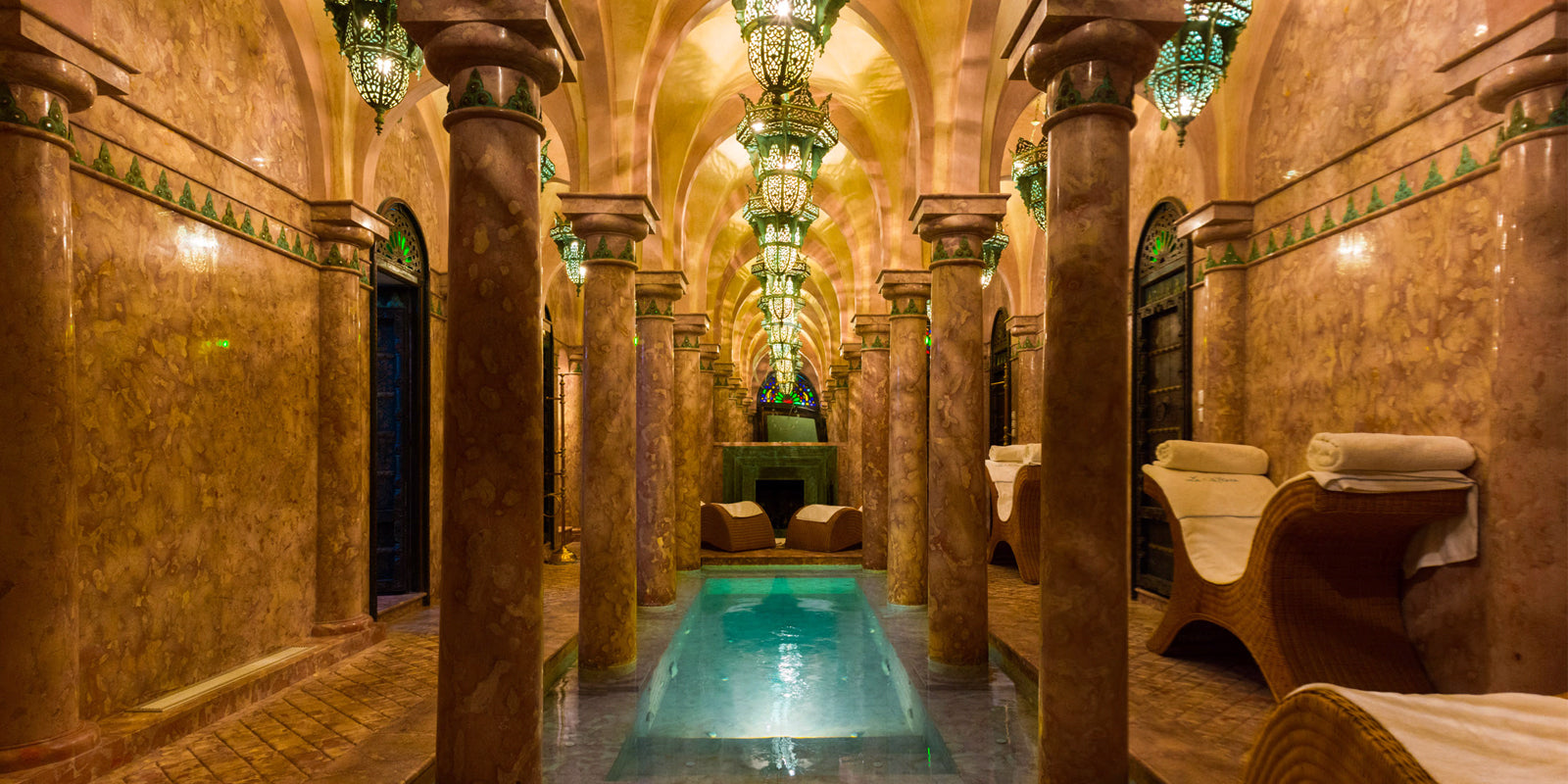
Hammams remain woven into Casablanca’s neighbourhood life, used regularly and without occasion. Stone floors warm gradually, steam settles low, and water is poured by hand from brass buckets. The sequence is steady and familiar: heat, rinse, scrub, rest, repeated without hurry.
Architecture supports the rhythm. Marble slabs, tiled walls, and vaulted ceilings are built to absorb moisture and wear, their surfaces smoothed through constant use. Voices lower, movement slows, and attention shifts inward. Time here is physical and contained, marked by temperature, water, and the simple act of mindful self-containment.



NEXT STEP → START CUSTOMIZING YOUR MOROCCO TRIP
Because we're from Morocco, and have lived throughout the Kingdom, we can offer you unmatched expertise in planning an unforgettable Morocco holiday.
What you can expect from Journey Morocco