




Our favourite stops in Fes
We never tire of the Jnan Sbil Gardens, a green oasis that offers a vital sensory reset from the intensity of the medina. Exploring the quiet Merenid Tombs at dawn allows you to hear the city wake up in a chorus of prayer and birdsong.

Beyond the Medina
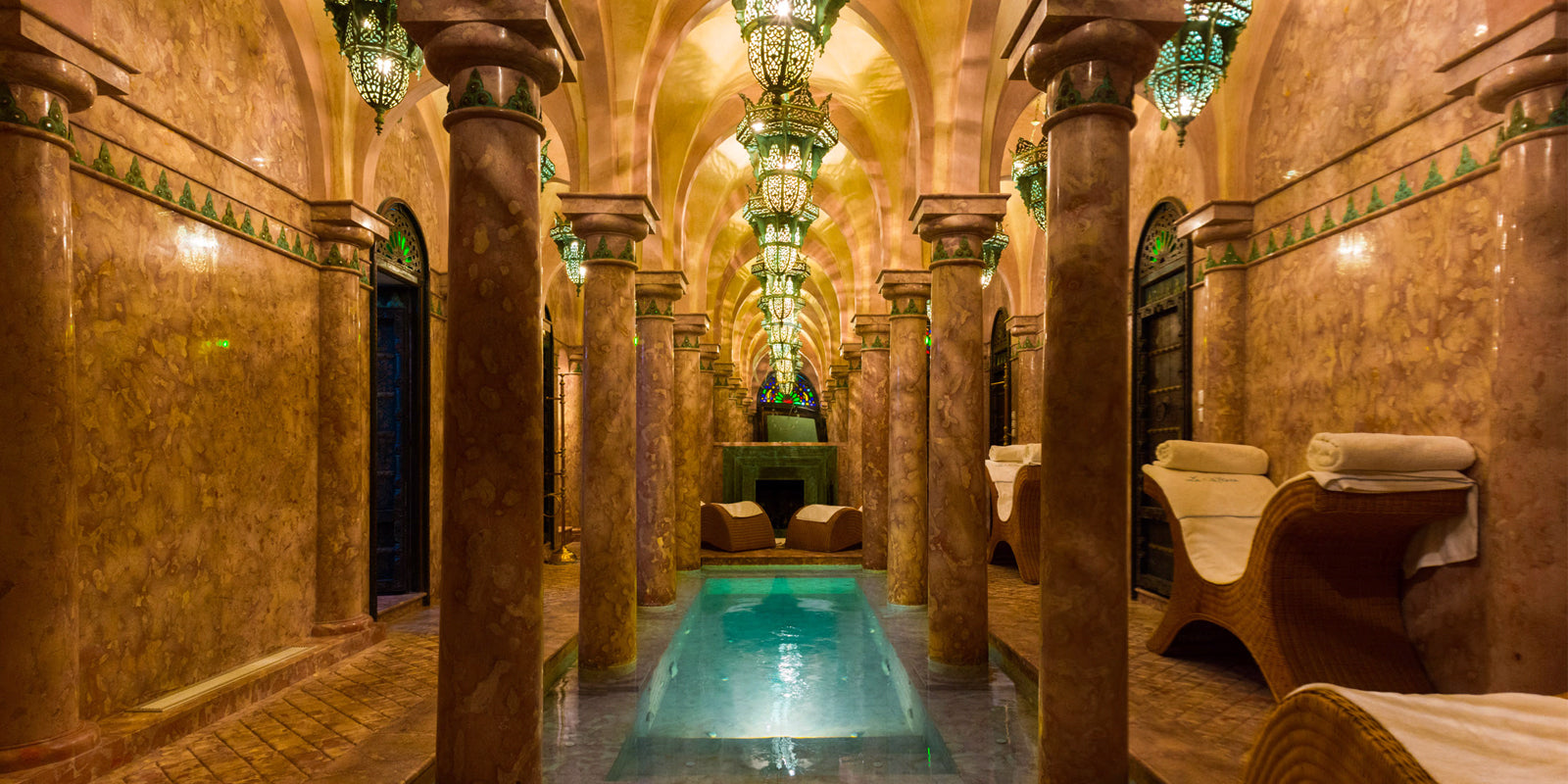
Sunlight slips across mosaic tiles and into a jewel-bright pool, where rose petals drift and the air carries a hint of mint.
Low cushions and woven rugs gather around the water, inviting you to sit and watch the day move through the riad. From spaces like this, three days in Fes begin to feel just right — long enough for the city’s ancient rhythms, layered craft and quiet intrigue to unfold.
Between wanderings and curiosities, you come back to relax at the hidden pool in your riad, and feel the city settle around you.

Scholars and Caravans
Set behind these carved doors is Al-Qarawiyyin, the world’s oldest continually operating university.
Here, theology, astronomy and law have been studied for more than a thousand years. Zellige, carved cedar and soaring arches frame a place where scholars once traded ideas carried by caravans from across Africa, Arabia and the Mediterranean.
What to See & Do in Fes
Fes, Morocco | A UNESCO-listed medieval city, alive with workshops, mosques and markets inside the world’s largest car-free quarter
From family-run weaving ateliers in Seffarine to the cedar-scented upper rooms of Funduq Nejjarine, these are places where Fassi craft and commerce are still lived in real time. From there, slip into Fondouk Tazi, an old caravanserai now home to metalworkers, saddle-makers and instrument builders, each tucked into vaulted rooms that hum with quiet concentration. Add a mint-tea pause on a riad roof above the Qarawiyyin and a visit inside a 19th-century merchant house in the Andalusian quarter, and you begin to sense the medina as layered, human, and deeply complex.

The royal palace
The great gates of the Dar el-Makhzen
Towering gilded doors rise beneath bands of zellige and carved stone, their scale only clear as people pass and pause below.
Light plays across metal and tile through the day, turning the palace frontage into a shifting surface of colour and reflection. The gates hold Fes’s place at the heart of Morocco’s imperial history.

Heartbeat of the old city
Bab Bou Jeloud, western gate of Fes el-Bali and one of the city's thirteen fortifications
Through the magnificent crenellated triple arches of the great Blue Gate, you step into Tala’a Kebira, the main street that runs the length of the medina.
Blue and green mosaics catch the light as people move in every direction, crossing from open streets of Fes' UNESCO-listed medina to become part of the pulse of the old city. Leatherworkers, potters and marquetry artisans still ply their craft behind open doors, skills passed down through generations. From here, cafés, workshops and market lanes gather and thicken, carrying the everyday life of Fes deep inside its walls.

One Thousand Years of Colour
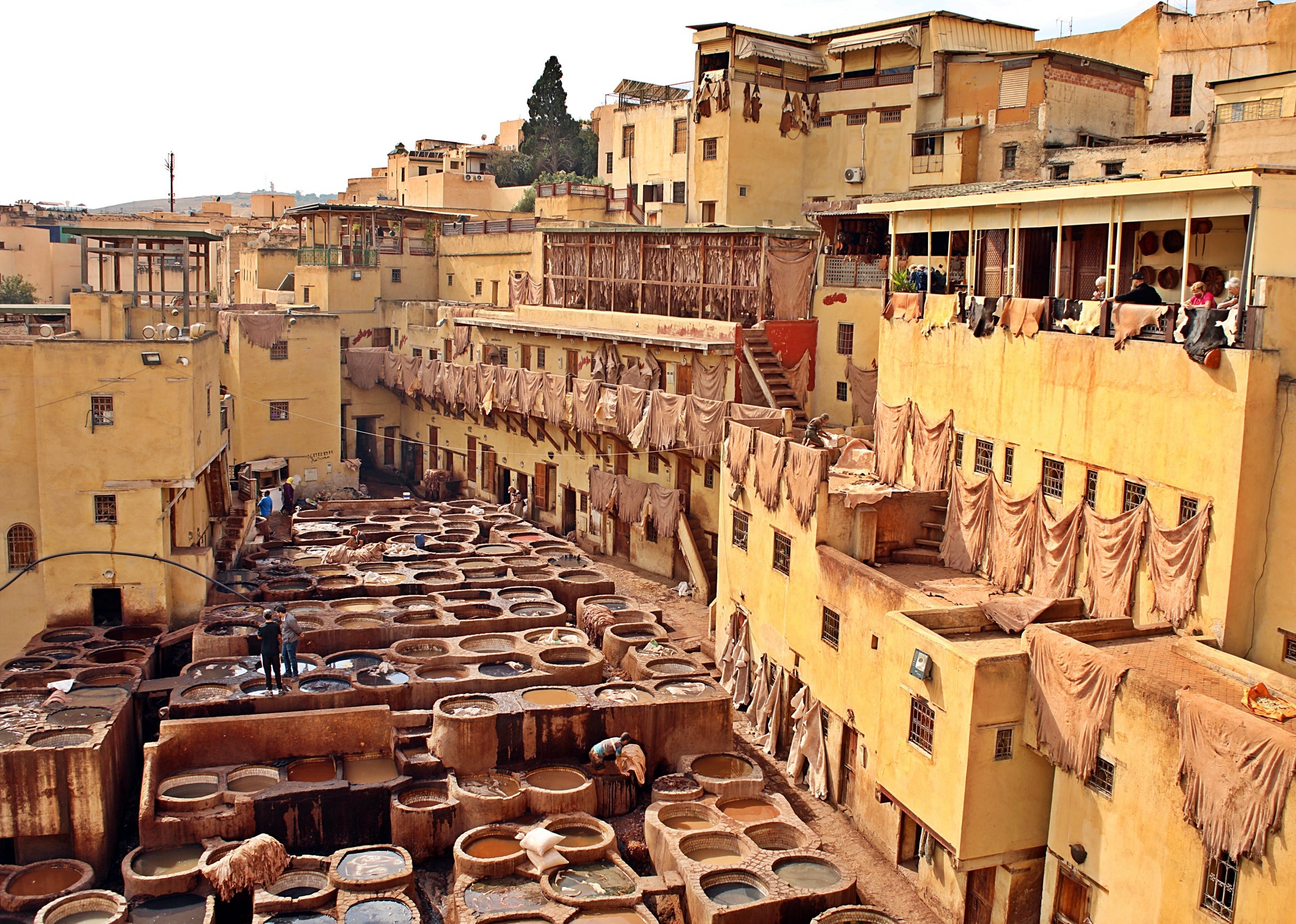
Chouara Tannery, operating since the 11th century at the edge of Fes el-Bali
From the rooftops, the tannery opens out like a living mosaic, with hundreds of stone vats filled with indigo, saffron, poppy and chalk.
Leather is worked by hand as they have been for almost a thousand years. Below, men wade through the dye pits with bundles of hides, their days set by sun and water as Fassi leather takes on its colour and depth. The air carries the sharpness of lime and the fresh sting of mint from the shops above, while smell, colour and labour combine in one of the city’s oldest working landscapes, little changed over time.

A living labyrinth
Beneath draped strips of cloth that temper the sun, the medina folds into a maze of cobbled streets, hidden doors and unexpected courtyards
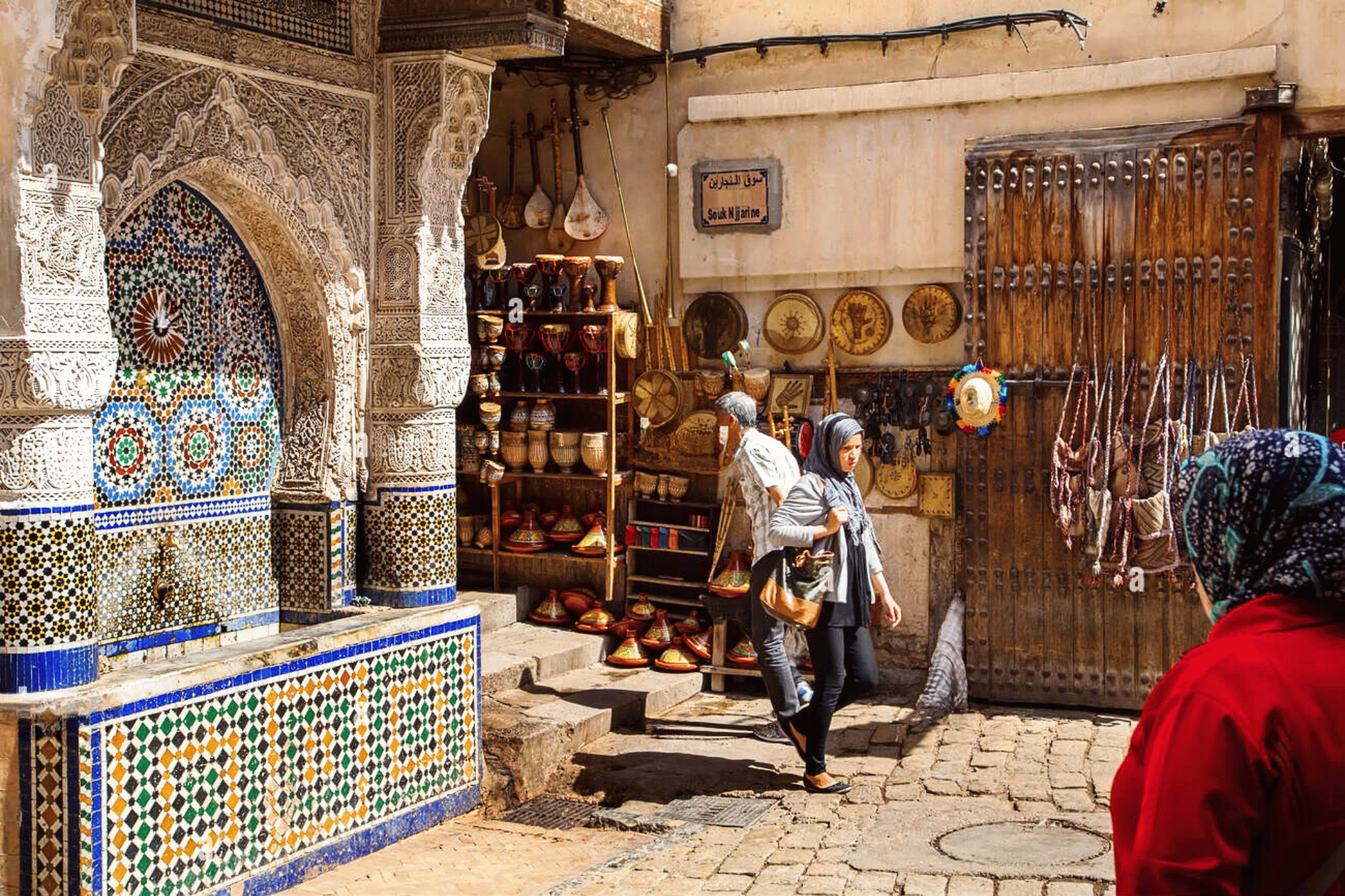
In the souk of Fes, lazy cats sleep on warm stone and shopkeepers lay out rugs, ceramics and carved wood for your consideration.
Zellige-lined public fountains still run with drinking water, drawing locals who pause to fill bottles before slipping back into the flow of alleys and market lanes. Somewhere between a bowl of spiced Fassi street food and the call of a metalworker shaping brass in his doorway, it becomes easy to lose your bearings — and just as easy to stumble into small, everyday scenes that feel as old as the city itself.

Enter the Madrasa
A sweeping plaza built to gather people, prayer and daily ritual beneath open sky
The Sahn of Al-Qarawiyyin forms the grand inner court of the world’s oldest continually operating university. Moroccan beldi, intricate carvings, and saturated zellige open out into an unexpected breadth inside the medina’s dense weave, with arcaded galleries tracing the edges in cool shade. Light, weather and footsteps move freely across the stone, worn smooth by more than a thousand years of study, prayer and passage.

higher perspectives
From abvove, Fes opens into a low, ochre sea of terraces, domed baths and slender minarets, with the call to prayer drifting across a maze of living rooftops
Our favourite panoramic view is from the top of the Museo Nejjarine.
From this vantage point, you can trace the medina’s full expanse—terraces stitched with daily life, domed bathhouses, pockets of green, and distant hills holding the whole city in place.
Laundry lines, satellite dishes and water jars sit alongside centuries-old masonry, all part of the same dense, working skyline. Up here, the scale of the old city becomes clear, its layered forms rolling outward beneath a wide Moroccan sky.

Fes is Morocco’s cultural and historical capital
Nowhere is the kingdom’s artistry and innovation more present than in the soaring architecture of the Fes
Cedar from the Middle Atlas, carved plaster and hand-cut zellige come together in spaces built to last for centuries
Their patterns are shaped by a belief that geometry reflects divine order. Horseshoe arches rise in measured rhythm, drawing the eye toward central fountains where water has long marked purity, renewal and spiritual focus. Across Fes, these materials and forms continue to frame daily life, carrying a tradition of craft, faith and precision that remains deeply alive.


Delight in An Intoxicating Sensory Fusion
As they have for centuries, the master perfumiers of Fes still mix custom fragrances on the spot
With concentrated precision, they draw on rare Moroccan flowers, cedarwood, oud, precious oils and orange blossom in small, deliberate measures. Shelves of glass jars hold rosewater, amber and dark, resinous oud beside glowing piles of saffron, cumin and paprika. Here, fragrance and flavour move side by side through the narrow lanes, forming one of the medina’s most charged and atmospheric corners.

The Soul of the Souk
Long before storefronts and supermarkets, the medina’s souks were the engine of Moroccan life
Caravans once carried saffron, cumin and dried citrus to these bazaars from across the Sahara and the Mediterranean, and today households still come to gather what will become the day’s meals.
In Fes, those traditions remain intact, with spices sold by sight and scent, grains scooped by hand, and merchants who know their produce as intimately as any chef. Moroccan cooking begins in the bazaar, built on freshness, balance and the patient layering of flavour that defines everything from slow-braised tagines to fragrant couscous. To walk these lanes is to see how food, trade and community have always been woven together, sustaining the city through centuries of change.

Protected by hills, fortified by gates
Life inside the old city has always unfolded in close quarters
Fes rises upward in tight, flat-roofed layers, each generation building on the last, with homes, workshops and courtyards pressed together along narrow lanes. Small windows and thick earthen walls keep interiors cool and private, while flat roofs provide space for drying herbs or collecting rain. The city’s terracotta tones come from local clay and lime plaster, giving every surface a soft, weathered colour that is renewed again and again by hand.
Today, more than 150,000 people remain inside the old medina. Beyond the gates, modern Fes spreads out in wide boulevards and newer districts, where most of the city’s two million residents now live.


NEXT STEP → START CUSTOMIZING YOUR MOROCCO TRIP
Because we're from Morocco, and have lived throughout the Kingdom, we can offer you unmatched expertise in planning an unforgettable Morocco holiday.
What you can expect from Journey Morocco